EtherCAT device profiles overview
A device profile defines the standardized interface and functions of a particular device type. EtherCAT supports several device profiles, so equipment from different vendors can be integrated.
Application-layer protocol overview
EtherCAT supports several protocols at the application layer, and different device profiles can coexist on the same EtherCAT network:
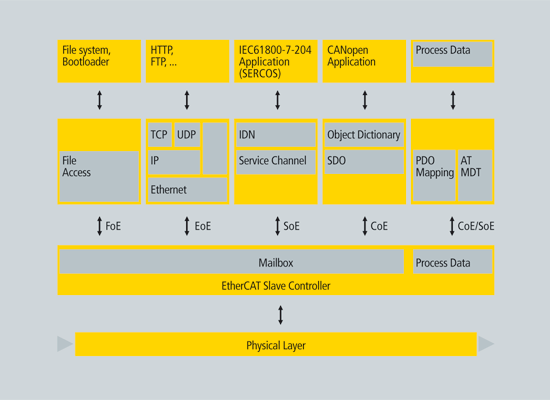
Figure: several device profiles coexisting in one EtherCAT system
Main protocol categories
General-purpose application protocols
CoE (CANopen over EtherCAT)
- Role: the most widely used application-layer protocol
- Applicable devices: I/O modules, servo drives, encoders, sensors
- Core mechanism: object dictionary, PDO, SDO
- Detailed documentation: CoE protocol in detail
CiA 402 - Servo drive protocol
- Role: standardized motion control protocol
- Applicable devices: servo drives, stepper motor controllers
- Core features: standard state machine, operating modes
- Detailed documentation: CiA 402 in detail
CiA 401 - Generic I/O protocol
- Role: I/O module standard
- Applicable devices: digital and analog I/O modules
- Detailed documentation: CiA 401 in detail
High-performance motion control
SoE (Servo Drive Profile over EtherCAT)
- Role: high-end motion control
- Standard basis: IEC 61800-7-204 (SERCOS)
- Application scenarios: machine tools, high-end packaging equipment
- Detailed documentation: SoE protocol in detail
Data transfer protocols
FoE (File Access over EtherCAT)
- Function: file transfer
- Application: firmware updates, configuration file management
- Detailed documentation: FoE protocol in detail
EoE (Ethernet over EtherCAT)
- Function: transparent Ethernet frame transfer
- Application: web servers, cameras, TCP/IP applications
- Detailed documentation: EoE protocol in detail
Gateways and diagnostics
AoE (ADS over EtherCAT)
- Function: routable communication
- Application: gateway devices, remote diagnostics
- Detailed documentation: AoE protocol in detail
VoE (Vendor Specific over EtherCAT)
- Function: vendor-specific protocol
- Detailed documentation: VoE protocol in detail
Functional safety
FSoE (Safety over EtherCAT)
- Certification: the protocol targets IEC 61508 SIL3 (this product does not claim certification)
- Detailed documentation: FSoE protocol in detail
Protocol combinations
Most EtherCAT devices support several protocols at the same time:
Typical servo drive:
├── CoE (CiA 402) ········· Standard motion control (required)
├── SoE ··················· Advanced functions (optional)
├── FoE ··················· Firmware update (common)
└── EoE ··················· Web diagnostics (optional)

Typical I/O module:
├── CoE (CiA 401) ········· Standard I/O access (required)
└── FoE ··················· Firmware update (optional)

Safety I/O module:
├── CoE (CiA 401) ········· General I/O access
└── FSoE ·················· Safety I/O access