Prerequisites (hardware / software)
Hardware requirements
Development host
- A PC, preferably Windows 10/11 IoT Enterprise (the primary delivery platform; the Linux edition is planned)
- CPU: at least 2 cores (using the DarraRT real-time driver requires 1 core to be isolated)
- Memory: 4GB or more
NIC
- An available Ethernet NIC (RJ45); the following models are recommended:
- Intel I210 / I350 (recommended)
- Realtek RTL8111 / RTL8168 (commonly integrated on motherboards)
- Any other standard Gigabit Ethernet NIC can be used
Choosing a NIC
An EtherCAT master does not need a dedicated hardware NIC; any standard Gigabit Ethernet NIC will do. Intel NICs are slightly better than Realtek in real-time performance, but the difference is small.
Slave devices
- At least 1 EtherCAT slave (a development board or a commercial slave), an Ethernet cable and a power supply
- Enhanced category five or category six Ethernet cable
Software requirements
Real-time components
| Component | Purpose | Required |
|---|---|---|
| DarraRT (Windows) | Windows real-time component, average 1.2 µs / max 4.5 µs jitter | Required on Windows |
| DarraRT (Linux) | Linux real-time component, average 0.8 µs / max 3.5 µs jitter | Required on Linux (planned) |
The real-time components must be installed
From the current version on, the DarraRT real-time components are the only channel the master runs through; the user-mode software frame path is no longer provided as a fallback. Without them, SDK initialization fails outright.
Development environment
| Language | Requirement |
|---|---|
| C# | .NET Framework 4.6.1+ or .NET 6+ (install DarraEtherCAT from NuGet) |
| Java | JDK 11+ |
| Python | Python 3.8+ |
| C | MSVC or GCC (C11) |
| C++ | MSVC or GCC (C++17) |
| Rust | Rust 1.70+ |
Other optional tools
- DARRA EtherCAT Master Tools — graphical configuration tool: scans the network and generates code
- Wireshark — for capturing and analyzing EtherCAT frames
Master implementation
Hardware requirements
- Standard NIC: no dedicated communication processor needed
- Passive NIC card: or the Ethernet MAC integrated on the motherboard
- Low CPU load: protocol handling does not consume host resources
Software support
- Multi-platform: Windows and Linux are supported; adaptation to real-time systems such as FreeRTOS and RT-Thread is planned but not provided in the current version
- Configuration tool: XML-format configuration files, with EtherCAT Network Information (ENI) import support
Slave implementation
Slave controller (ESC)
- Dedicated chip: the protocol is handled in hardware, and real-time behavior is guaranteed by the chip
- Multiple interfaces:
- 32-bit parallel I/O (simple devices need no CPU)
- Serial SPI (8-bit microcontroller)
- 8/16 parallel interface (complex devices)
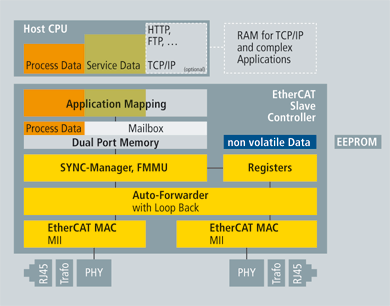
Figure: slave hardware - FPGA design with a host CPU
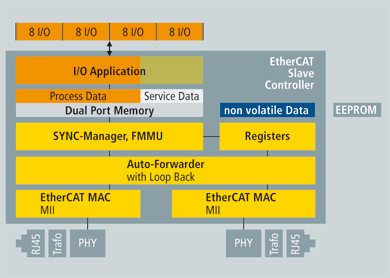
Figure: slave hardware - FPGA design with direct I/O